Showing posts with label email. Show all posts

Tuesday, September 23, 2008

Facebook Email Spoof Contains Trojan Horse

Websense® Security Labs(TM) ThreatSeeker(TM) Network has discovered a new malicious social-engineering spam campaign masquerading as official emails sent by the popular Web 2.0 social-networking site, Facebook. The email is spoofed to appear from the domain facebookmail.com, an official domain used by Facebook for their outbound emails when notifying their users of an event.

It is common for Facebook to send an email to notify their users when another Facebook user adds them as a friend on the social network. However, the spammers included a zip attachment that purports to contain a picture in order to entice the recipient to double-click on it. The attached file is actually a Trojan horse.

A login page to Facebook is included in the body of the email. We have previously alerted on our discovery via our HoneyJax system about a viral Facebook phishing campaign, and thus would not be surprised if the login page presented was merely a fake front to a phishing site. However, an examination of the HTML form's source code shows that it was indeed passing the user name/password to Facebook itself. This may be to increase the legitimacy of the email to evade reputation-based spam filters.

To view the details of this alert, click here.

Tuesday, July 10, 2007

Spammers Automatically Creating Hotmail And Yahoo Accounts

BitDefender researchers found that spammers are easily bypassing the captcha system, to automatically set up new e-mail accounts to use to send out waves of spam.

By Sharon Gaudin, InformationWeek
Spammers have a new trick up their sleeves. According to researchers at BitDefender Labs, spammers are automatically creating Yahoo and Hotmail accounts, and using a Trojan to help them send waves of spam. The spammers, according to the security company, have figured out how to outwit the "captcha" security system. That's the one which won't allow a new e-mail account to be created until the creator correctly types in the twisted letters depicted in an image.
A piece of malware, Trojan.Spammer.HotLan.A, actually has been set up to access the e-mail accounts, pull down encrypted e-mails from another site, unencrypt them, and then send them to e-mail addresses stored in yet another Web site. "They've found a way to bypass the captcha system by using optical character recognition," said Vitor Souza, a manager at BitDefender, in an interview. "The software reads the images and transforms it into text. Once it bypasses the captcha system, it enables them to automatically creates the e-mail accounts." Souza said the automatic system creates accounts extremely quickly. "It's beyond what we've ever seen before," he said, adding that it can create 500 new e-mail accounts every hour and up to 15,000 a day.
"With this kind of speed, they can send spam from thousands of different accounts and that's a lot more resources for them," he added. "[Companies] have to look at this new threat," said Souza. "The captcha system has become a norm in the industry for setting up e-mails and different kinds of accounts. Responsible companies, like Yahoo and Hotmail, will have to find a way to fight this through more sophisticated security systems or they're going to have to find a new system all together." The spam is set up to currently lure unsuspecting users to a site that advertises pharmacy products, BitDefender researchers said.

Tuesday, February 13, 2007

Gmail Finally Really Open to Everyone

Nearly three years after Gmail was first released, the free Web-based e-mail from Google is being opened up for anyone in the world. Beginning Wednesday, everyone and their mother can sign up instead of having to get an invite from a Gmail-using friend. Google has been phasing out the invitation restriction geographically, with total general availability offered in Europe last week and in North America, South America and Asia this week. The service is still in beta test mode, however.

Many people thought Google's ad-based searchable e-mail service with an unheard-of gigabyte of free storage was an April Fool's Day joke when it was announced on April 1, 2004. Privacy advocates and others objected to Google serving up ads based on the content of the messages. Making Gmail accounts available only by invitation, and thus a scarce commodity, increased their allure and led to auctions of invites on eBay. Later, rival Web-based e-mail services followed with full search functions, vast amounts of storage and ads.
Source: News.com


Friday, October 27, 2006

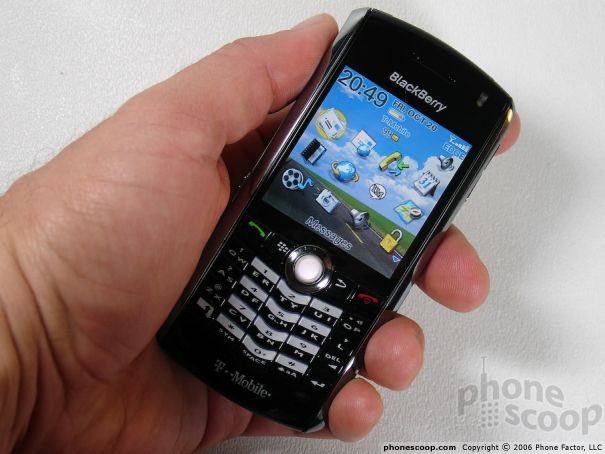
PhoneScoop Review: BlackBerry Pearl

by Eric Lin / Phone Scoop
RIM BlackBerries, long the standard phone for any high powered executive to carry, have begun to draw more interest among mainstream users. Maybe it's because people see famous stars carrying them around now. Or maybe it's because they've been talked about for so long.
The Pearl is RIM's first attempt to grab some mainstream market share. It adds a and camera and media player to the Blackberry's email and phone skills and packs it all into a slimmer and dare we say, sexier body. Unfortunately, though they updated the features and design, they seem to have ignored the interface.
If you've never used or held a Blackberry before, the Pearl simply looks elegant. The smooth, slim shape and dark color scheme give the Pearl a classy look. With the screen off, it doesn't look geeky or even like a Blackberry.
If you've ever handled a Blackberry before, the Pearl is simply shocking. You'll wonder what happened to your old Blackberry. The Pearl is significantly thinner and smaller - about half the volume - of even the smallest 7100 series devices. It makes the 8700s look positively huge and clunky.
The Pearl is quite small for a smartphone - even a smartphone with a numeric keyboard. Considering it has 2 extra columns of keys for its hybrid keyboard, the Pearl's size is even more impressive. Its thinness is the most impressive aspect. You wonder how there's room for circuit boards and screens and such inside, especially when you see how large the battery is.
Like the SLVR and other North American thin candy bar style phones, the Pearl looks wide, but only because it is thin. In truth it is not any wider (or taller) than the SLVR or many other phones. But it looks wide because its shape accentuates its thinness. Not only is it the same width as your average candybar, but the sides have mitered edges - visually subtracting size and making it easier and more comfortable to grip than similarly shaped phones.

Read the entire article -- including specifics
on the three S's (Screen, Signal, Sound) -- here.


Wirefly (InPhonic)