Microsoft's IPO opened on the stock market on February 14, 1986 -- 21 years ago, today. The asking price of the IPO was $21.00 per share. At that time, the Microsoft Corporation was making much of its revenue on Macintosh software, BASIC language interpreters, and the PC operating system MS-DOS. Does anyone remember "edlin"?
After the IPO, Microsoft began a tremendous run; earning large increases in revenue over the next two decades. By 2003, a $2,100 investment at the 1986 IPO offering price was worth $1.5 million.
Wednesday, February 14, 2007
Technology History - Microsoft Goes Public

Tuesday, February 13, 2007
Internet Explorer Multiple Vulnerabilities
TITLE: Internet Explorer Multiple Vulnerabilities
SECUNIA ADVISORY ID: SA24156
VERIFY ADVISORY: http://secunia.com/advisories/24156/
CRITICAL: Highly critical
IMPACT: System access
WHERE: From remote
SOFTWARE:
Microsoft Internet Explorer 6.x
http://secunia.com/product/11/
Microsoft Internet Explorer 7.x
http://secunia.com/product/12366/
DESCRIPTION:
Some vulnerabilities have been reported in Internet Explorer, which can be exploited by malicious people to compromise a user's system.
1) An error within the instantiation of COM objects (Imjpcksid.dll and Imjpskdic.dll) not intended to be instantiated in Internet Explorer can be exploited to cause a memory corruption.
2) Another error within the instantiation of COM objects (Msb1fren.dll, Htmlmm.ocx, and Blnmgrps.dll) not intended to be instantiated in Internet Explorer can be exploited to cause a memory corruption.
3) An error within the parsing of FTP server responses can be exploited to cause a memory corruption via a specially crafted response sent to the FTP client in Internet Explorer.
Successful exploitation of the vulnerabilities allows execution of arbitrary code.
SOLUTION: Apply patches.
Internet Explorer 6 for Windows XP SP2
Internet Explorer 7 for Windows XP SP2
PROVIDED AND/OR DISCOVERED BY:
1) Reported by the vendor.
2) The vendor credits H D Moore, BreakingPoint Systems.
3) The vendor credits iDefense Labs.
ORIGINAL ADVISORY: MS07-016 (KB928090)
EDITORIAL: The revolution in Internet browsing, Microsoft's secure browser, Internet Explorer 7 is... a flop. Just a few months after the much-heralded release of IE7, we find that it's just as full of holes as IE6. The Trustworthy Computing initiative hasn't worked. Internet Explorer is still a huge problem for network security admins around the world.
Gmail Finally Really Open to Everyone
Nearly three years after Gmail was first released, the free Web-based e-mail from Google is being opened up for anyone in the world. Beginning Wednesday, everyone and their mother can sign up instead of having to get an invite from a Gmail-using friend. Google has been phasing out the invitation restriction geographically, with total general availability offered in Europe last week and in North America, South America and Asia this week. The service is still in beta test mode, however.
Many people thought Google's ad-based searchable e-mail service with an unheard-of gigabyte of free storage was an April Fool's Day joke when it was announced on April 1, 2004. Privacy advocates and others objected to Google serving up ads based on the content of the messages. Making Gmail accounts available only by invitation, and thus a scarce commodity, increased their allure and led to auctions of invites on eBay. Later, rival Web-based e-mail services followed with full search functions, vast amounts of storage and ads.
Source: News.com
Monday, February 12, 2007
Archaeological Remains Point To Exact Location Of Second Temple Of Jerusalem
Source: ScienceDaily
While scholars have put forth various assessments for the location of the Second Temple in Jerusalem, a Hebrew University of Jerusalem professor says that archaeological remains that have so far been ignored by scholars point to the exact location, which is in a spot that differs from prevailing opinion.
Drawing (Temple 1) shows Prof. Patrich's description of the
location of the Temple compound (the rectangle defined by a
solid line in the center of the drawing).
(Drawing by Leen Ritmeyer)
The location identified by Prof. Joseph Patrich of the Hebrew University Institute of Archaeology places the Temple and its corresponding courtyards, chambers and gates in a more southeasterly and diagonal frame of reference than have earlier scholars.
In spotting the Temple in this way, Patrich concludes that the rock, over which the Dome of the Rock mosque was built in the 7th century [A.D.] is outside the confines of the Temple. The rock is considered by Moslems to be the spot from which Muhammad ascended to heaven and for Jews the place at which the binding of Isaac took place.
Patrich bases his proposal on a study of a large underground cistern on the Temple Mount that was mapped by British engineer Sir Charles Wilson in 1866 on behalf of the Palestine Exploration Fund. The giant cistern, 4.5 meters wide and 54 meters long, lay near the southeastern corner of the upper platform of theTemple Mount. It had a southeasterly orientation with branches extending north and south.

Examining the location and configuration of the cistern together with descriptions of the daily rite in the Temple and its surroundings found in the Mishna (the Rabbinic Oral Tradition compiled in the 3rd century [A.D]), Patrich has demonstrated that this cistern is the only one found on the Temple Mount that can tie in with the Mishna text describing elements involved in the daily purification and sacrifical duties carried out by the priests on the altar in the Temple courtyard. On this basis, he says, one can "reconstruct" the placement of the laver (a large basin) that was used by the priests for their ritual washing, with the water being drawn by a waterwheel mechanism from the cistern. After this purification, the priests ascended the nearby ramp to the sacrificial altar. By thus locating the laver, the water wheel, the ramp and the altar, one can then finally map, again in coordination with the Mishna, the alignment of the Temple itself and its gates and chambers.
All of these considerations have led Patrich to come up with a diagram of the Temple and its surroundings that place the Temple further to the east and south than earlier thought and at a southeasterly angle relative to the eastern wall of the Temple Mount, and not perpendicular to it as earlier assumed. It is this placement which also leaves the Dome of the Rock outside of the Temple confines (see drawing).
Prof. Patrich stressed that his research concerning the location of the Temple is strictly academic in nature, and that political connotations should not be attributed to it. [See WorldNewsDaily for another article, with more pictures and drawings.]
Note: This story has been adapted from a news release issued by The Hebrew University of Jerusalem.
Sunday, February 11, 2007
Experts Offer Free Back Pain Advice February 15th
Hotline focuses on preventing, easing pain in middle age
(HealthDay News) -- Baby boomers plagued by back pain can get free, expert advice from a national hotline on Thursday, February 15, sponsored by the American Physical Therapy Association (APTA).
During hotline hours, 9 a.m. to 5 p.m. EST, physical therapists will be available to answer callers' questions about injury prevention, exercise and ways to prevent back pain. The toll-free number is 1-877-633-3278. Back pain is a common complaint among middle-aged Americans as they deal with hectic daily schedules, increasingly demanding jobs, and caring for children, grandchildren and aging parents.
Boomers, who account for a quarter of the U.S. population, tend to have more active lifestyles than previous generations. "Baby boomers are as active as they were when they were younger, but now they're living with chronic low back pain or osteoarthritis. These conditions as well as others can benefit greatly from physical therapy intervention," Jennifer Gamboa, a private practice physical therapist in Arlington, Va., said in a prepared statement. "Frequently, patients may unknowingly exacerbate their (back) pain by exercising improperly or by having poor posture," and physical therapists can help identify and correct those behaviors, Gamboa said.
Thursday, February 08, 2007
Technology History - Compaq Computer Corporation
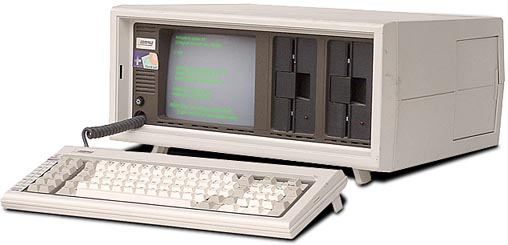
Compaq enjoyed a magnificent run through the 1980s and 1990s. As the price wars heated up during the early 21st century, Compaq fell on hard times. Hewlett-Packard acquired Compaq in May, 2002.
- 1982: February - Compaq Computer Corporation is founded by Rod Canion, Jim Harris, and Bill Murto, all former senior managers of Texas Instruments who were unhappy with how TI was running its computer business and they thought they could do a better job.
- 1982: November - Compaq Computer introduces the Compaq Portable PC.
- 1983: March - Compaq Computer begins shipping the Compaq Portable PC.
- 1983: October - Compaq Computer introduces the Portable Plus.
- 1983: December - Compaq Computer makes its first public stock offering, raising US$67 million.
- 1986: February - Compaq Computer introduces the Compaq Portable II.
- 1986: April - Compaq Computer joins the Fortune 500 list faster than any company in history.
- 1986: April - Compaq Computer ships its 500,000th personal computer.
- 1986: September - Compaq Computer introduces the first 16-MHz Intel 80386-based PC, the Compaq Deskpro 386.
- 1987: October - Compaq Computer introduces the Compaq Deskpro 386/20.
- 1987: October - Compaq Computer introduces the 20-MHz Compaq Portable 386.
- 1987: November - Compaq Computer makes its 1 millionth personal computer.
- 1988: February - Compaq Computer reports sales for the year reach US$1.2 billion, setting the record as the fastest company to reach that mark.
Wednesday, February 07, 2007
10 Things You Shouldn't Buy New
 As a follow-up to yesterday's post, I am including Liz Weston's MSN Money article that provides advice on the other end of the consumer sprectrum - 10 Things You Shouldn't Buy New. Again, here is the list of items (in no particular order):
- Books
- DVDs & CDs
- Little kids' toys
- Jewelry
- Sports equipment
- Timeshares
- Cars
- Software & console games
- Office furniture
- Hand tools
As someone who has used hand tools for every ounce I could get out of them, I would disagree that buying used hand tools is a smart choice. By the time many of them make it to the flea market or pawn shop, they are completely worn out. As with some other items, it's also nice to have a warranty on hand tools. We all know things break -- that's why we need many of our hand tools in the first place.
Tuesday, February 06, 2007
10 Things You Should Never Buy Used
 MSN Money's Liz Pulliam Weston has written an informative, concise article detailing ten things you should never buy used. Rather than quote the entire article, here is the short list and a link the Liz's piece:
- Laptops
- Car seats
- Plasma TVs
- DVD Players
- Vacuum cleaners
- Camcorders
- Shoes
- Mattresses
- Wetsuits
- Helmets
Monday, February 05, 2007
The World's Most Expensive MP3 Player

TrekStor received an order from Russian-Canadian billionaire and owner of the Midland Formula 1 team, Alex Shnaider, to develop the world's most expensive MP3 player. This unique, custom-made device was created based on TrekStor's i.Beat organix, winner of 14 accolades.
The casing of the organix is cast in 750 gold (18 karat) and adorned with 63 diamonds (one-karat). The player is also embellished with a small chain that includes aquamarine gems. Jewelers Wenthe in Mannheim/Germany put over 100 hours of pains-taking handiwork into the exquisite gadget. The Trekstor website offers this marketing piece:

i.Beat organix FM golden – a shade of luxury for every man
Following the incredible hype associated with the i.Beat organix Gold, the magnificent EUR 20,000 (~$25,895.00US) jewelry item in 750 gold, TrekStor is now offering a gold colored variant for smaller purses. The i.Beat organix FM golden not only captivates through its conspicuous gold colored UV lacquer and small decorative chain, but also through its exceptionally high capacity rechargeable battery (up to 25 hours playing time) and outstanding sound quality. It includes an integrated radio, an organic display, a second headphone jack, a recording function for dictating and an integrated line in jack. Together with its rechargeable lithium polymer battery, the i.Beat organix FM golden weighs just 40 grams. The power pack is charged via the high speed USB 2.0 interface. The player is delivered with two pairs of Sennheiser headphones and available with one or two gigabytes storage capacity.
Sunday, February 04, 2007
Worldwide Pinhole Photography Day
There is nothing particularly special about this photograph of the water board intake on the River Thames, except that it was made without a lens. Taken on 35mm film, it makes a decent although slightly soft 6"x4" print. Photographers viewing this might comment on the fact that the painted iron work just inches from the camera and the distant houses are almost equally sharp.
Pinhole cameras were known long before photography, and still have a certain interest, not least because of the sharpness in depth they provide. A pinhole doesn't focus an image, so objects at different distances are more or less equally sharp.
April 29, 2007 is this years Worldwide Pinhole Photography Day, so you have plenty of time to prepare for it. It's a simple event to take part in - all you need to do is to register on the site, take a photograph on that day and upload it to the web site. You can see the pictures taken in previous years from 2001-2006 in the gallery on the site. Why not put one of yours there this year?
If you have a camera - film or digital - which takes interchangeable lenses, taking pinhole images could not be more simple. The feature Simple Pinhole tells you all you need to know to take pinhole pictures with any interchangeable lens camera. If you don't have a suitable camera, it is easy to make your own, and you find links to helpful sites in the Pinhole Photography section.

Pinhole cameras were known long before photography, and still have a certain interest, not least because of the sharpness in depth they provide. A pinhole doesn't focus an image, so objects at different distances are more or less equally sharp.
April 29, 2007 is this years Worldwide Pinhole Photography Day, so you have plenty of time to prepare for it. It's a simple event to take part in - all you need to do is to register on the site, take a photograph on that day and upload it to the web site. You can see the pictures taken in previous years from 2001-2006 in the gallery on the site. Why not put one of yours there this year?
If you have a camera - film or digital - which takes interchangeable lenses, taking pinhole images could not be more simple. The feature Simple Pinhole tells you all you need to know to take pinhole pictures with any interchangeable lens camera. If you don't have a suitable camera, it is easy to make your own, and you find links to helpful sites in the Pinhole Photography section.
Subscribe to:
Posts (Atom)